


Within the academic ecosystem, conferences are not merely venues for presenting findings. They are an essential part of how knowledge develops. Attending conferences allows researchers to:
test ideas before publication,
receive early feedback from scholarly communities,
build academic networks, and
open opportunities for interdisciplinary or inter-institutional collaboration.
For graduate students and early-career researchers in particular, conferences also function as academic training environments. They offer a space to experiment with scholarly argumentation, respond to critical questions, and position one’s work within broader academic conversations.
A single research project rarely produces just one scholarly output. In practice, the same project can generate multiple conference presentations at different stages of development. Understanding these formats helps researchers make better use of conference opportunities.
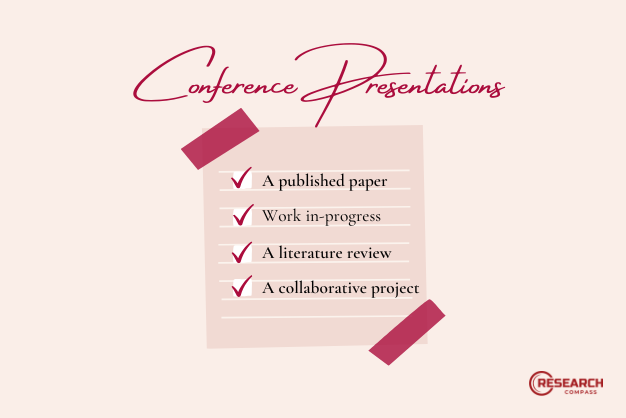
1. Completed or published research: The safe option
Submitting a completed or published study is the least risky option. It ensures methodological accuracy and provides a well-developed narrative when presenting.
This type of presentation works well if your goal is to:
share validated findings,
disseminate the contribution of a published paper,
increase academic visibility and recognition, and
connect with scholars working on related topics.
The benefits include:
strengthening professional credibility,
extending the reach of your research across academic communities, and
opening opportunities for collaboration or citation.
Presentation tip:
Rather than simply repeating the content of the published article, emphasize practical implications, new research directions, or insights that emerged after publication. This keeps the presentation intellectually engaging for the audience.
2. Work-in-progress studies: Using conferences for feedback
Conferences are also valuable spaces for presenting research that is still in progress. Many conferences actively encourage this type of submission.
This format is particularly useful when you want to:
test your research design,
receive feedback on methodology or theoretical framing, or
refine the direction of the project before completing the study.
However, this approach carries some challenges. Early-stage research may lack sufficient data or theoretical depth, which can weaken the initial impression. There is also a small risk that ideas could be developed faster by others if they move more quickly after hearing them.
Presentation tip:
Focus on your research question, conceptual framework, and methodological approach rather than presenting incomplete details. This allows you to gather meaningful feedback while still protecting the core idea.
3. Literature reviews or conceptual papers: Demonstrating intellectual depth
If your research project is still building its theoretical foundation or if you are working on a long-term project, submitting a literature review or conceptual paper can be an effective strategy.
The main goals of this type of presentation are to:
synthesize existing knowledge,
demonstrate a deep understanding of the field,
position your project within the broader research landscape, and
receive feedback on theoretical and conceptual approaches before conducting empirical work.
Not all conferences accept purely conceptual papers, and literature reviews may appear less engaging if they lack concrete examples or analytical insights.
Presentation tip:
Highlight the research gaps you intend to address. This makes the presentation more dynamic and helps audiences see how your project contributes to ongoing scholarly debates.
4. Collaborative or team-based projects: learning through partnership
If you are working as a research assistant or collaborating within a research team, presenting a joint project can also be a valuable option.
This format allows you to:
share results from collaborative research,
introduce new methodologies or datasets, and
build connections between research groups.
Often the presentation is delivered by one representative of the team or by several members together. For research assistants, this can be an excellent opportunity to demonstrate presentation skills, deepen professional relationships with supervisors, and explore future collaborative possibilities.
A strategic way to think about conferences
One useful approach is to view conferences as part of the research lifecycle:
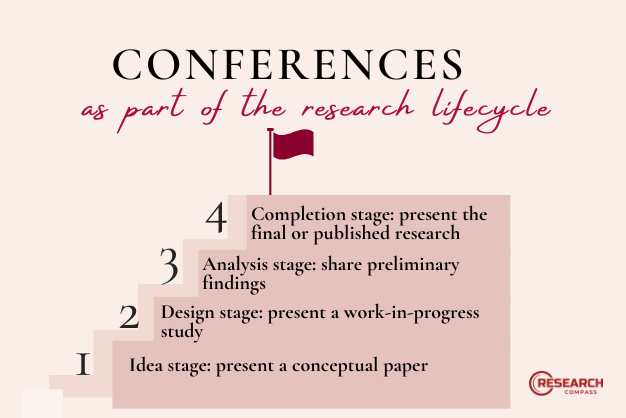
Idea stage: present a conceptual paper
Design stage: present a work-in-progress study
Analysis stage: share preliminary findings
Completion stage: present the final or published research
Approaching conferences this way allows a single project to generate multiple scholarly interactions while maximizing the value of each stage of research development.
Conferences are important intellectual spaces in the process of knowledge production. Choosing the presentation format that aligns with both the stage of your project, and your personal goals helps you make the most of these opportunities.
Before submitting to a conference, it is worth asking yourself:
Do I want to strengthen my academic profile, refine my research through feedback, or expand my professional network?
Preparing your presentation with this clarity in mind will make the experience far more meaningful.
Mini checklist: Before submitting a conference proposal
Is the objective of your presentation clear (sharing findings, receiving feedback, or building connections)?
Does the project offer a distinctive idea or theoretical contribution?
Are the slides concise and designed with the audience in mind?
Are you prepared to engage with critique and discussion?
Conferences are not just milestones in a research career. They are spaces where scholars learn, grow, and present themselves within the academic community.
Have you ever presented at a conference?
Which type of presentation did you find most valuable?
Feel free to share your experience. These conversations help all of us learn.