


I have never been able to memorize an entire song in my life. And yet, now I can sing dozens of them by heart.
Why?
Because every night, I listen to them and sing along with my daughter before she goes to sleep.
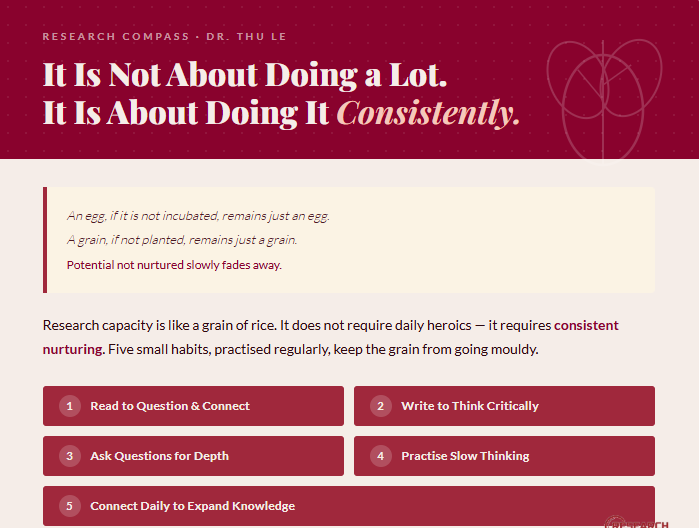
Learning, research, and skill development follow a very similar logic. It is not about doing a lot. It is about doing it consistently. Small accumulations, repeated over time, eventually lead to real growth.
There is a children’s song that reflects this logic perfectly:
An egg, if not incubated, remains just an egg.
An egg, warmed day and night, becomes a chick.
A grain, if not sown, remains just a grain.
A grain, once sown, grows into a field of rice.
The message is simple but powerful.
An egg left untouched will eventually rot. A grain left unused will grow mold. Potential that is not nurtured slowly fades away. This is true for seeds, and it is just as true for research capacity.
People often say that doing research means reading academic papers every day. I cannot do that and I suspect many others cannot either.
There are periods when I read intensively, such as when I am writing a paper or working on a specific project. There are also periods when I do not read at all. But I never stop doing research, at least not in a broader sense of what research means.
What follows are a few habits I maintain to keep the “grain” from going moldy, even when I am not reading journal articles every day.
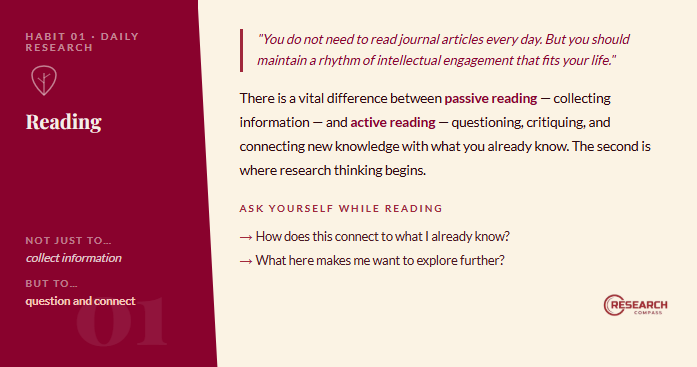
1. Reading: Not just to know, but to question and connect
Reading is a foundational habit for researchers. But there is an important distinction between:
Passive reading: collecting information
Active reading: questioning, critiquing, and connecting new knowledge with what you already know
You do not need to read journal articles every day. But you should maintain a rhythm of intellectual engagement that fits your life.
For example:
Follow researchers, professors, or colleagues in your field on platforms like LinkedIn, Twitter, or ResearchGate. Even short posts or discussions can stimulate new thinking.
Read academic blogs, analyses, or newsletters. These are often more accessible and easier to sustain than full-length articles.
More importantly, whenever you read anything, build the habit of asking:
How does this connect to what I already know?
What here makes me want to explore further?
This is where research thinking begins.
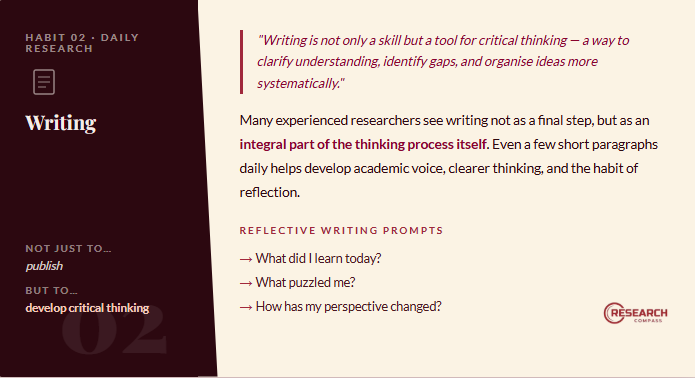
2. Writing: Not just to publish, but to develop critical thinking
Writing is not only a skill but a tool for critical thinking.
When you write, you are forced to clarify your understanding, identify gaps in your thinking, and organize your ideas more systematically. This is why many experienced researchers see writing not as a final step, but as an integral part of the thinking process itself.
You do not need to write papers every day. But you can:
Write about an interesting observation from your research or teaching
Record emerging ideas, unanswered questions, or contradictions you notice
Keep a reflective journal not to describe your day, but to analyze it
Ask yourself:
What did I learn today?
What puzzled me?
How has my perspective changed?
Writing regularly, even a few short paragraphs, helps you develop academic voice, clearer thinking, and a habit of reflection. These are essential foundations for serious research work.
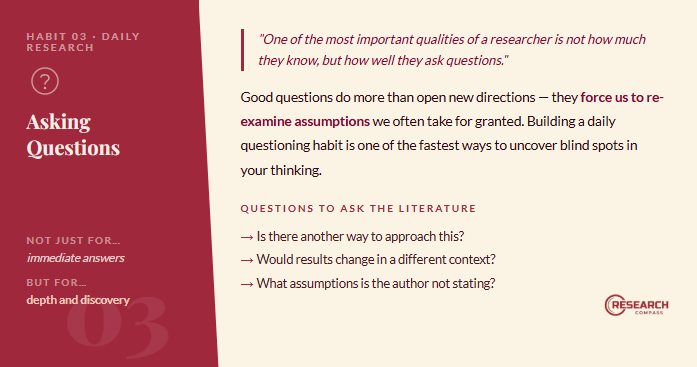
3. Asking questions: Not for immediate answers, but for depth
One of the most important qualities of a researcher is not how much they know, but how well they ask questions.
Good questions do more than open new directions. They force us to re-examine assumptions we often take for granted.
Try building a daily habit of:
Writing down at least one question, inference, or hypothesis related to your field
Questioning what you read:
Is there another way to approach this?
Would the results change in a different context culturally, temporally, or with a different population?
What assumptions is the author making but not stating?
Engaging in discussions with colleagues or research communities is equally important. Being challenged and challenging others are those of the fastest ways to uncover blind spots in your thinking.
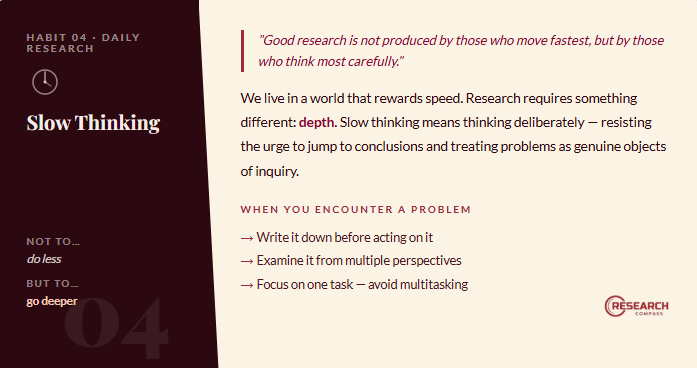
4. Practicing slow thinking: Not to do less, but to go deeper
We live in a world that rewards speed and volume. Research requires something different: depth.
Good research is not produced by those who move fastest, but by those who think most carefully.
“Slow thinking” does not mean doing less. It means thinking deliberately.
When you encounter a problem, resist the urge to jump to conclusions. Instead:
Write it down
Examine it from multiple perspectives
Treat it as a focus of inquiry
This habit not only improves the quality of your thinking but also allows you to notice details others might miss.
It also requires limiting multitasking. Research consistently shows that multitasking reduces cognitive quality. Focus on one task at a time.
5. Connecting daily: Not just to network, but to expand knowledge
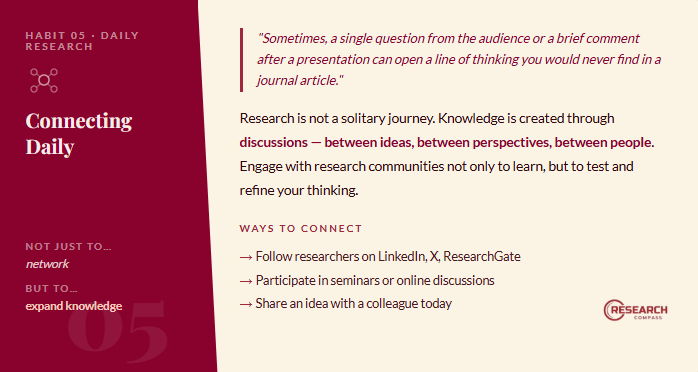
Research is not a solitary journey even if it sometimes feels like one. Knowledge is created through discussions:
between ideas
between perspectives
between people
Engage with research communities not only to learn, but to test and refine your thinking.
Connect with researchers in your field on platforms like LinkedIn, X, Bluesky, or ResearchGate
Participate in seminars, conferences, or online discussions
Sometimes, a single question from the audience or a brief comment after a presentation can open a line of thinking you would never find in a journal article.
No one becomes an excellent researcher just in a day, a month, or even a year. And no one needs to read academic papers every day to make progress. What makes the difference is not intensity but consistency and depth.
Each day, you can plant a small seed:
read a short text and ask a question
write a brief reflection
spend ten minutes thinking deeply about an unresolved issue
share your idea with a colleague
These small seeds, if planted consistently and in the right conditions, will eventually grow into a field.
What seed have you planted today for your research journey?