


“I finished the article, but I still didn’t really understand it.”
When I first began learning how to do research, I often complained to my friends about this. For beginners, reading research articles can feel genuinely difficult. Dense terminology, unfamiliar structure, and an overwhelming volume of information can leave readers exhausted, confused, and frustrated after spending hours on a single paper.
After a while, I realized I was making a very common mistake: I was trying to do too much while reading. I always read from beginning to end. At the same time, I was taking notes on vocabulary, sentence structures, and content. One article could take me an entire afternoon, sometimes even a whole day. Yet what stayed with me afterward was often fragmented. I felt slow, discouraged, and not much closer to real understanding.
What I have learned over the years is this:
Reading academic articles becomes much easier once you are clear about what you are trying to understand from that article.
In other words, what is your purpose for reading?
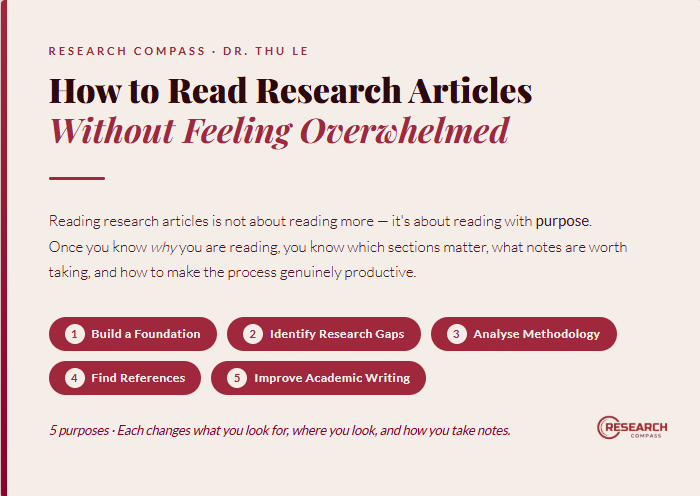
In this piece, I want to share five of the most common purposes for reading research articles; whether you are just entering research or have been on this journey for years.
1. Reading to build a foundation for a new research area
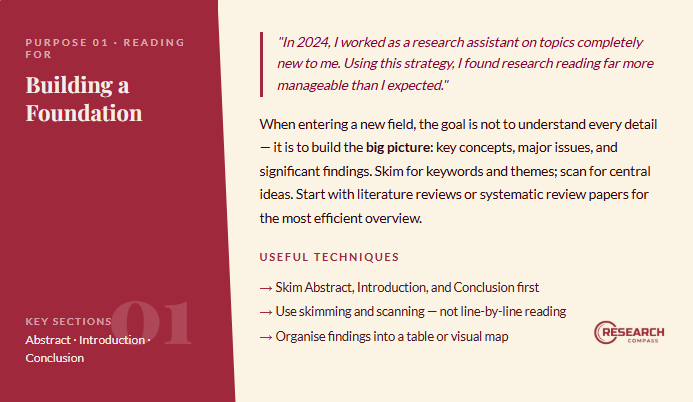
This is how I read when starting a new project or entering a field that is completely unfamiliar to me. At this stage, I am not trying to understand every detail. My goal is to build the big picture: the key concepts, the major issues under discussion, and the most significant findings the field has produced so far.
For this purpose, I focus on three sections:
Abstract: to quickly grasp the overall study
Introduction: to understand the context, the problem, and the author’s framing
Conclusion: to identify the most important findings and why they matter
The most useful techniques here are skimming and scanning. I skim for keywords and major themes, then scan for the central ideas. I also note striking findings and organize them into a table or visual map so I can see the overview more systematically.
One important suggestion is to start reading literature reviews or systematic review papers. They are often the most efficient way to understand a research area. With regular empirical articles, you do not always need to read the full Methodology or Findings sections unless you specifically want to understand how the topic has been studied.
In 2024, I worked as a research assistant for two professors on topics that were completely new to me: Belonging in digital learning and Music teacher education. Using this strategy, I found research reading far more manageable and productive than I expected.
2. Reading to identify research gaps and develop research ideas
This is one of the most intellectually demanding purposes for reading, and it is also what distinguishes a passive reader from an active researcher.
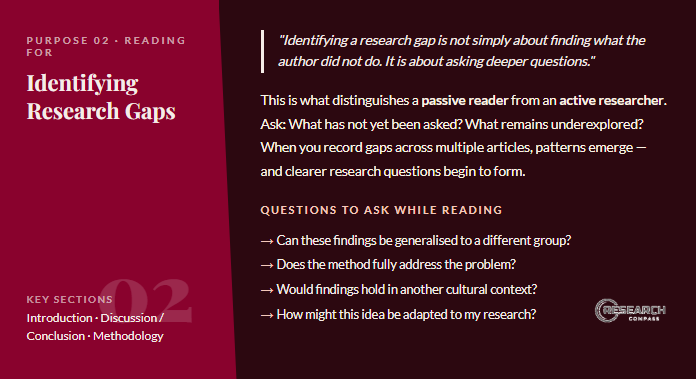
Identifying a research gap is not simply about finding what the author did not do. It is about asking deeper questions: What has not yet been asked? What has not been sufficiently tested? What remains underexplored or underexplained? This is where original and meaningful research ideas begin to take shape.
When reading for this purpose, I pay closest attention to three sections:
Introduction: Authors often state or imply the gap when explaining why their study is needed
Discussion/Conclusion: Limitations and suggestions for future research are often the most direct sources of possible gaps
Methodology: Methodological choices can also reveal gaps; for example, a large-scale quantitative study may leave personal experience unexplored in ways that qualitative work could address
As I read, I often ask myself questions such as:
Can these findings be generalized to a different group?
Does the method fully address the problem?
Would the findings hold in another educational or cultural context?
How might this idea be adapted to my own research?
When you record these gaps across multiple articles, patterns begin to emerge. That is often where clearer and more systematic research questions begin to form.
3. Reading to analyze research methodology
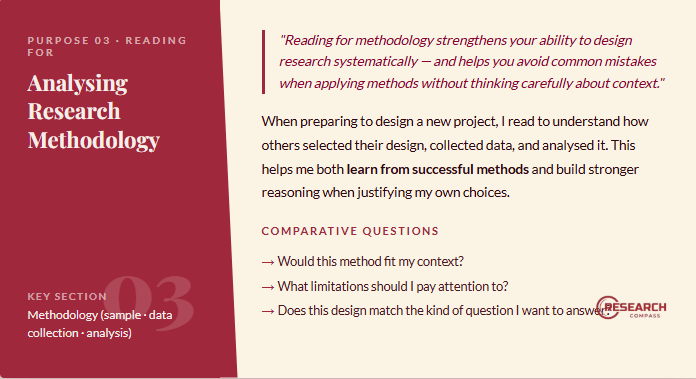
Research methodology is the backbone of any scholarly study. I usually read with this purpose when I am preparing to design a new project and want to understand how other researchers selected their design, collected data, and analyzed it.
Naturally, the main focus here is the Methodology section. This is where the author explains the sample, the data collection tools, and the analytical process. Reading this section carefully helps me in two ways. First, it helps me learn how to apply or adapt methods that have already been used successfully; second, it gives me stronger methodological reasoning when I later need to justify my own choices.
I often compare the method used in the article with my own research questions:
Would this method fit my context?
What limitations should I pay attention to?
Does this design match the kind of question I want to answer?
Comparing methods across several studies is also one of the best ways to determine which approach is truly suitable for different kinds of research questions.
Reading for methodology strengthens your ability to design research systematically and reliably. It also helps you avoid common mistakes when applying methods without thinking carefully about context.
4. Reading to find references and citations for my own paper
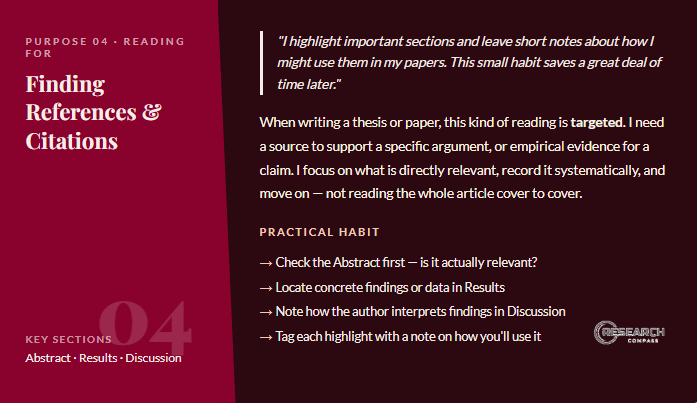
When writing a thesis or academic paper, accurate and relevant citation is essential. I usually read for this purpose when I need a source to support a specific argument or when I need empirical evidence for a claim.
This kind of reading is much more targeted. I usually focus on:
Abstract: to quickly determine whether the article is relevant
Results: to locate concrete findings or data I may cite
Discussion: to see how the author interprets the findings and connects them back to theory
I also highlight important sections and leave short notes about how I might use them in my papers. This small habit saves a great deal of time later when I return to the source while drafting.
5. Reading to improve academic language and writing
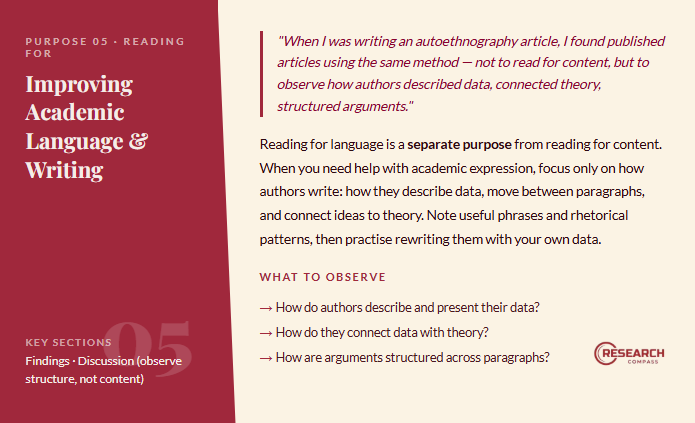
This is a purpose many people either overlook or confuse with the others. I used to read for content while also collecting useful vocabulary and sentence structures. In reality, I was trying to do two different things at once and not doing either particularly well. Now I separate those purposes.
When I need help with academic expression, I read specifically for language.
For example, when I was writing an article using autoethnography, I was unsure how to present and analyze my own data while also connecting it with previous studies. So I found published articles using the same method and focused only on the Findings and Discussion sections. I was not reading for content in the usual sense. I was reading to observe how authors described data, connected data with theory, structured arguments, and moved between paragraphs.
I note useful phrases and rhetorical patterns, then practice rewriting them in relation to my own data. Reading for language not only improves writing. It also helps develop a deeper sense of how academic ideas are presented clearly, coherently, and persuasively.
Reading research articles is not a skill most people master immediately. And there is no single “correct” way to read every paper. What makes the difference is not reading more. It is…
Reading with more purpose
Once you know why you are reading, you also know which sections deserve your attention, which sections you can leave for later, and what kind of notes are actually worth taking. Reading becomes more efficient, less exhausting, and much more meaningful.
You can also combine purposes in a single reading session. I often read at once for a broad understanding of the field, for methodological insight, and for identifying research gaps. These goals often support one another naturally.
And one final point: do not read in isolation from your note-taking system. Use tools such as AI, Zotero, or MAXQDA to record and organize what you learn. Research reading rarely involves just one or two articles, and our minds cannot retain everything. Without an effective strategy for annotation and organization, even purposeful reading becomes difficult to sustain.
What do you most often read research articles for?
Do you have a reading strategy that works especially well for you?
I would love to hear how others approach this part of the research journey.