


“Here, here, here.”
The receptionist at the dental clinic pointed to the form in front of me and said exactly those three words. If this had happened to me years ago, it probably would have stayed with me all day. I would have read into it, questioned it, wondered whether something more was going on beneath that tone.
Are they dismissing me because I’m an international student? Or do they simply assume I don’t understand English?
But the version of me today responded differently. Not because I’ve become indifferent, but because I’ve learned to pause to create a small space before interpreting.
Looking back, I think years of doing research have shaped how I respond to moments like this though perhaps not in the way people might expect.
It’s not that research taught me to avoid my emotion. It’s that research taught me to notice when emotion is overtaking judgment.
There are four thinking habits from research that I find myself carrying into everyday life not as a formula, but as a lens.
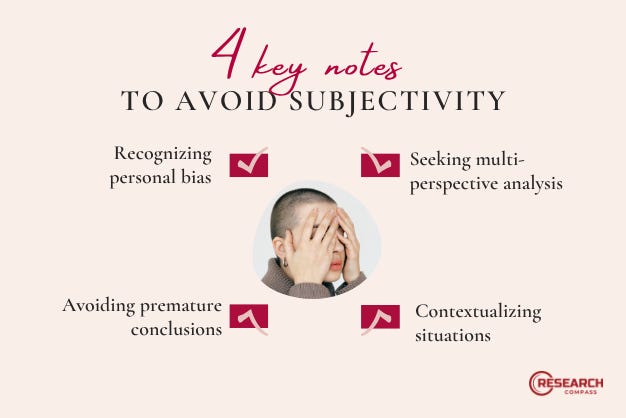
1. Recognizing personal bias
There is a common misconception in qualitative research: that a good researcher is one who is completely objective, someone who keeps their emotions and personal experiences entirely out of the data. But Braun & Clarke (2021) have argued the opposite: Researcher subjectivity is not something to be eliminated, but a resource to be critically recognized and reflected upon.
What does that look like in practice? It doesn’t mean I had no emotional reaction to the receptionist. I did. But I recognized that my reaction was being affected by my identity as an international student who had sometimes felt invisible. Recognizing that didn’t make the reaction disappear. But it created a small distance between feeling and conclusion.
This is what researchers call reflexivity, a disciplined practice of critically interrogating what we do, how and why we do it, and what influences our interpretations.
2. Seeking multiple perspectives
Triangulation — gathering information from multiple sources — is a principle in qualitative research designed to avoid over-reliance on a single data point. In everyday life, I draw on that same spirit when I ask myself: Is there another plausible explanation for what I just experienced?
But I also want to be honest about something: seeking multiple perspectives does not mean all interpretations are equally valid, or that I am always obliged to sympathize with someone who has made me uncomfortable. Sometimes, after considering things carefully, I still conclude that the behavior was inappropriate. What matters is the process: that I examined the situation deliberately, rather than reacting on instinct.
3. Avoiding premature conclusions — and learning to live in uncertainty
In research, premature closure is one of the greatest risks in qualitative analysis. When we rush to conclude, we close the door on more complex dimensions of what the data might be telling us.
Braun & Clarke (2021) put it in a way that has stayed with me: to do qualitative research well, one must learn to live in uncertainty, not because answers don’t exist, but because reality is almost always more layered than any quick conclusion allows.
The moment at the dental clinic was small. But it reminded me of that habit: don’t jump into the conclusion of the story too quickly. The receptionist may have been exhausted. She may have repeated that same routine hundreds of times that day. And — this is something I will never know for certain — she may have meant nothing by it at all.
4. Contextualizing situations
Contextualization is one of the foundational principles of qualitative inquiry. When analyzing a behavior or a phenomenon, we cannot isolate it from the system in which it occurs: Its social, institutional, personal, cultural, and historical dimensions all shape its meaning.
This does not mean every behavior can be explained away. Some actions are wrong regardless of context. But in this case, context helped me resist the impulse to place myself at the center of a story in which I was, most likely, just a small detail in someone else’s long day.
What I want to say in the end is not that research teaches us to stop feeling. Emotion is part of being human, and in qualitative inquiry, as Braun & Clarke remind us,
subjectivity is not the enemy of understanding. It is, in many ways, the very material of it.
What research has taught me is something more subtle: how to notice when I am interpreting and when I am judging. How to create a small pause between what happens and the meaning I assign to it. How to hold a question open, not because I have no opinion, but because reality tends to be more complex than what surfaces in the first moment.
And sometimes, that is also how I manage to move through life a little more lightly, not because I no longer feel discomfort, but because I have learned not to let a small moment define an entire day.
Braun, V., & Clarke, V. (2021). Thematic analysis: A practical guide. SAGE.