


Last week, while driving home, I almost hit a truck. It wasn’t heavy traffic. The truck didn’t brake suddenly. It was a brief moment of overconfidence on my part.
For a few seconds, my heart raced. There was a flash of panic. Thankfully, I regained control, braked in time, and avoided what could have been a serious accident. I might not be sitting here writing this otherwise.
After I steadied myself, an unexpected thought appeared in my head:
Research isn’t that hard. Driving is harder.
Last year, one of the failures that hurt me most was failing the Canadian G (full) driving test three times.
In Ontario, obtaining a permanent driver’s license requires passing three stages:
G1 – a knowledge test. You may drive legally, but only with a fully licensed driver (5+ years of experience) beside you.
G2 – a road test covering residential and highway driving. You may drive independently, but the license is valid for five years.
G (Full) – a highway-focused road test granting permanent driving privileges, recognized in some other countries, including Vietnam.
Years ago, when I was rejected from several PhD scholarships, I didn’t cry. When journal submissions were rejected, I remained composed. Yet each time I failed the driving test, I cried uncontrollably.
The more I reflected, the more I realized the two journeys share striking similarities.
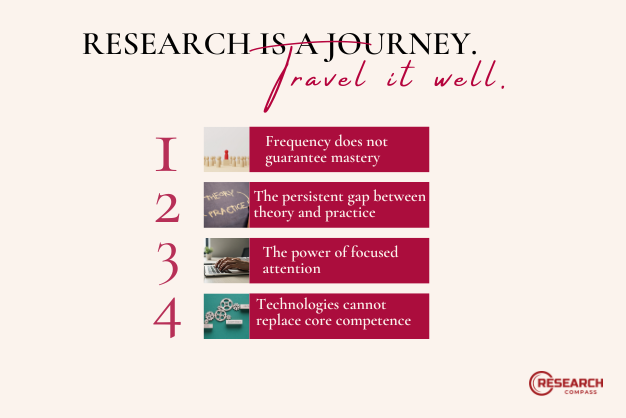
Doing more does not mean doing well
I have held a G2 license for four years. I drive regularly both on local roads and highways. Some trips span hundreds of kilometers. I also drive my child to school daily.
I look like an experienced driver, but failing the full license test forced me to confront an uncomfortable truth: driving frequently does not mean driving correctly. It does not mean meeting standards. It does not mean mastering the skill.
Looking back at my failed attempts, I realized:
When merging onto highways, I hesitated instead of accelerating decisively.
When changing lanes, I lacked confidence.
On my third test, I missed a right-turn signal from the car ahead and failed to yield appropriately.
Last week’s dangerous moment came from the same root: familiarity and competence.
Many researchers do a great deal: read extensively, collect abundant data, and write many manuscripts. But quantity does not guarantee methodological rigor, coherent argumentation, or analytical depth.
Experience becomes competence only when paired with reflexive awareness:
What exactly am I doing?
How am I doing it?
Does it meet disciplinary standards?
Can I justify my decisions methodologically?
Quantity does not equal quality. Habit does not equal mastery. A real researcher must remain intellectually humble, willing to learn, to refine skills, to abandon ineffective habits, and to grow. Doing more does not mean doing right. And certainly not doing well.
The gap between knowing and doing
I did not fail the driving test because I didn’t know the rules. I understood speed requirements and highway regulations clearly. I knew where I made mistakes. The issue was not knowledge. It was execution under real pressure.
There is always a gap between knowing and doing, between theory and practice.
During our graduate schools, we are exposed to theory, frameworks, and methodological procedures. Yet when confronted with an actual research project, many struggle to apply those principles appropriately within specific contexts.
Research competence is not built from “knowing.” It is built from doing—repeatedly—making mistakes, revising, and reflecting.
You may experience this personally. Sometimes you could explain a method fluently. But when designing a study, collecting data, or conducting analysis, uncertainty emerged not from lack of intelligence, but from lack of embodied practice.
Like merging onto a highway: I knew I needed to accelerate confidently. But only when placed in real traffic, under time pressure, did I understand what decisiveness truly required.
The gap between theory and practice is not a sign of failure. It is evidence that we are in the right place to learn.
Multitasking is an illusion. Focus is power
Driving is a perfect example of multitasking: monitoring speed, reading signs, observing surrounding vehicles, making split-second decisions. In life, we juggle multiple roles: family, primary employment, side projects, study, research. High-quality research requires sustained periods of deep focus.
During my PhD, I managed coursework, worked as a teaching assistant, attended projects as a research assistant, wrote my doctoral dissertation, and collaborated with colleagues. I maintained quality by reducing multitasking intentionally: dedicating one or two full days to a single task before shifting to another.
That rhythm preserved clarity and coherence in my thinking.
Multitasking may make us busy.
Only focus allows us to work well.
Tools are helpful — But they cannot replace competence
The reason behind last week’s moment was my overreliance on a built-in supportive tool. On highways, I often turn on cruise control. It maintains speed and distance automatically. It allows my feet to rest. But during the rain and snow, the system disengages automatically. That day, it turned off—and I did not notice immediately. Out of habit, I assumed the car was regulating distance.
Tools can support us. They must never replace us.
With the rise of AI, this principle is more urgent than ever. AI resembles cruise control. If we allow tools to lead entirely, to read for us, write for us, analyze for us, even think for us, the risk is not merely weaker scholarship. The greater risk is gradual erosion of our own research capacity.
The solution is not to reject AI. Like cruise control, AI can be an effective assistant:
synthesizing large bodies of literature,
suggesting structures,
supporting preliminary drafts,
accelerating routine tasks.
But it must not drive. The researcher remains responsible for:
formulating research questions,
making methodological decisions,
conducting analysis and interpretation,
upholding academic integrity throughout.
After all, both driving and research are journeys that demand presence, self-awareness, and continuous adjustment. Even when we hold degrees, licenses, titles, or years of experience, we remain learners.
Research is not difficult because it is complicated. It is difficult because it requires honesty about our capabilities, about the gap between what we know and what we can execute.
That gap will be filled through practice, reflection, and sometimes failure.
Self-driving vehicles may come to use in the future. But in research, no tool will ever replace human judgment. Tools may assist the journey; they must not determine the direction.
I failed my driving test three times. I have been rejected from journals. Those moments did not slow me down. They made me steadier.
Research is not a destination. It is a long road. Each stumble teaches us to drive with greater skill, greater care, and greater responsibility to ourselves, to knowledge, and to the scholarly community.