


Have you ever read a journal article and found yourself more confused the further you went? You follow the author’s argument but feel unsure what you’re looking for, unsure which information actually matters.
If so, I want you to know: that’s not necessarily a sign that you’re a poor reader. It often comes down to one of three causes.
First, you haven’t defined your reading purpose. You don’t really know why you’re reading this particular article, what you’re looking for, what you hope to walk away with. Without a clear purpose, every paragraph looks the same, and you have no basis for distinguishing what’s central from what’s peripheral. I’ve written a separate piece on this, which you can find here.
Second, you’re not yet familiar with the structure of a research article. Every section, from Abstract, Introduction, Literature Review, Findings, Discussion, to Conclusion serves a distinct function. If you don’t understand what each section is designed to do, you won’t know what to expect from it, and it becomes easy to read without focus.
Third, and this one surprises many people, sometimes the problem is the article itself. Not every paper is well written. Some lack coherence between the research aim, research questions, and data analysis. Some have messy presentation and inconsistent argumentation. And when an article has these problems, readers often blame themselves rather than recognizing the weakness in the text.
The “Flashlight” Tactic
One of the simplest strategies I regularly use is what I call the “flashlight” mode: identify 1–2 core keywords from the article, then use Ctrl+F to find where those keywords appear, how many times, and whether their distribution is consistent throughout the paper.
It sounds simple. But this is actually an analytical move, not just a search function.

A real example: When the main keyword disappears from the most important section
Let me share a specific example from a paper I once read:
Reading the abstract and the stated purpose, “This study examined the experiences of student teachers as they engaged in a global project to develop their knowledge and understanding of intercultural learning using ICT”, I could identify two core keywords: intercultural learning and ICT.
I ran Ctrl+F and searched for “intercultural” (1 from the figure below) across the full text: 13 results (2 from the figure below).
That might seem adequate. But this PDF was bilingual, meaning only about 6 of those instances appeared in the English section. And more importantly, when I looked at where they appeared:
1 in the title
1 in the abstract
2 in the literature review
2 in the methodology
Not once in the Findings, Discussion, or Conclusion.
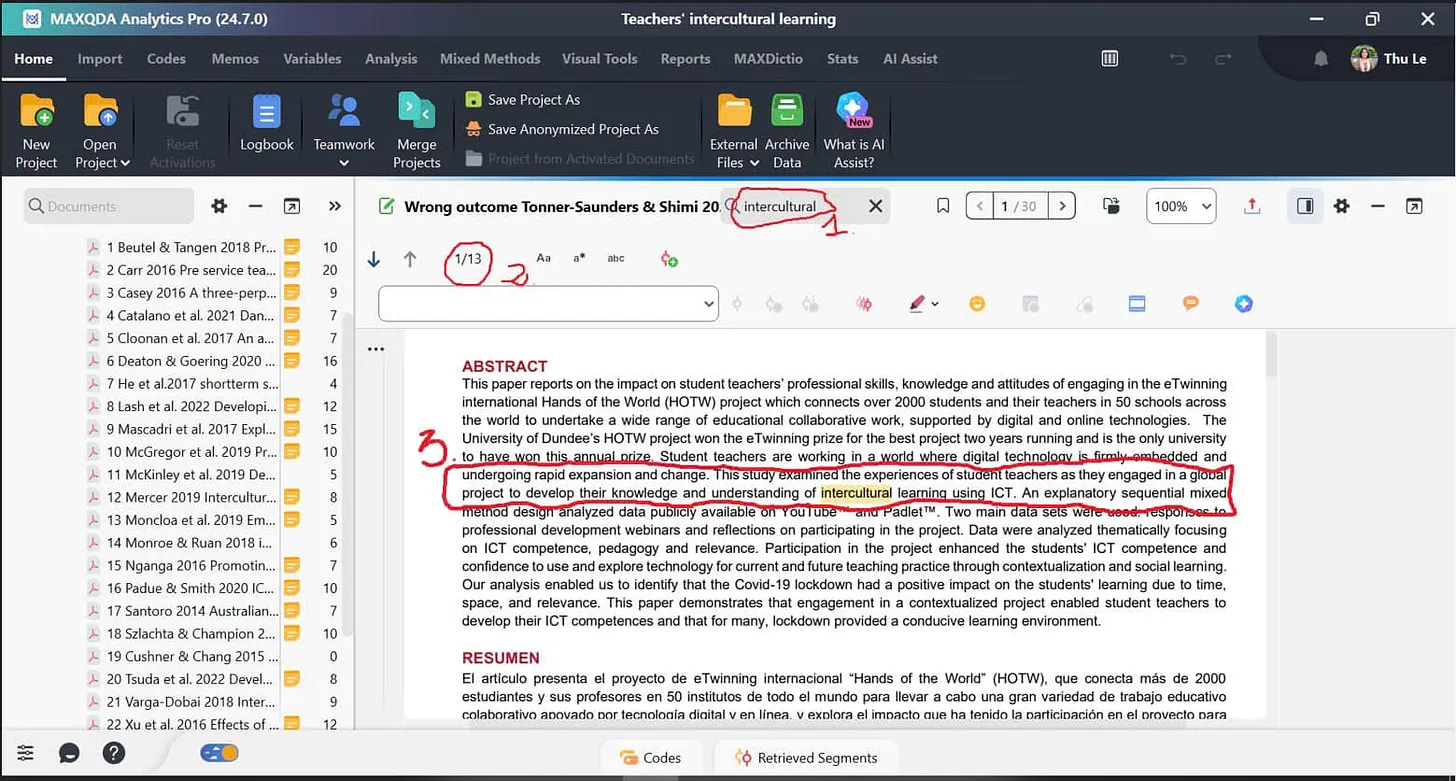
You can already see the problem: one of the paper’s two core keywords “intercultural learning” was entirely absent from the most critical analytical sections of the article. This is a systematic misalignment between what the authors claim to study and what the paper actually analyses.
When I read the Findings and Discussion carefully, I found that the entire analysis focused on participants’ development of ICT skills, not intercultural learning. In other words, the paper was analyzing one thing while the title and abstract framed it as something else.
This isn’t merely a wording issue. In academic research, alignment between research aim, research questions, and findings is a fundamental quality standard. When there is a significant gap, readers, especially those searching for literature on intercultural learning, risk being misled. The paper surfaces in relevant search results but ultimately cannot deliver the data or analysis it appears to promise.
This is also why I often remind readers: not every published paper is equally rigorous, even among peer-reviewed work.
Why the “Flashlight” tactic matters
Tracking keywords doesn’t just help you read faster. It does three important things:
It gives you direction: You know what you’re looking for and where to find it, rather than reading sequentially from beginning to end without a compass.
It saves time. You can skip sections that aren’t relevant to your reading purpose, instead of being pulled into every paragraph.
It helps you evaluate article quality. You can detect papers that are internally inconsistent, or that make promises larger than what they actually demonstrate.
A practical note: if a paper uses many keywords, or if the author uses synonymous terms (for example, switching between “intercultural competence” and “cross-cultural learning”), run your search multiple times with different variations.
Mini-checklist: Apply this today
Before reading: Identify 1–2 core keywords from the title and abstract.
While reading: Use Ctrl+F to track the keyword, note not just how often it appears, but which sections it appears in.
After reading: Cross-check: does the keyword appear consistently throughout, especially in the Findings and Conclusion? If not, the paper may be promising more than it delivers.
Research is hard. Reading critically is harder. But this “flashlight”, a tactic that takes less than five minutes, can help you read more intelligently, detect problems more quickly, and feel less lost when you sit down with a difficult text.
Try it with the paper you’re reading this week. Then tell me, where does the flashlight lead you?