


A colleague reached out to me recently. She said that even after her supervisor had explained it several times, she still couldn’t quite tell the difference between a model and a theoretical framework and more to the point, she didn’t know how to use either of them with genuine intention in her own research.
I wasn’t surprised. This is one of the most pervasive points of confusion in academic research not only among beginners, but sometimes among experienced researchers as well. Much of that confusion stems from the fact that these terms are frequently used interchangeably in published academic work, and explained in inconsistent ways across disciplines, sometimes even within the same field.
But the confusion runs deeper than terminology. When a researcher cannot clearly distinguish between these four concepts, the consequences can be quite serious: a theory gets named but never connected to the research question; a framework gets listed like a menu rather than argued like a system; an approach gets chosen but sits in tension with the theory it is supposed to serve. These are precisely the points where editors and reviewers tend to desk reject manuscripts.
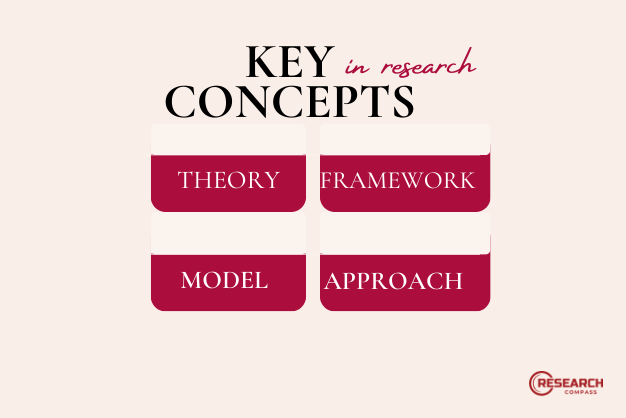
This piece distinguishes the differences and relationships between Theory, Model, Framework, and Approach and offers practical guidance for using each of them accurately and purposefully in your research.
1. Theory — The Foundation That Explains Why
A theory is a systematically constructed set of concepts, definitions, and principles often grounded in historical, cultural, and social foundations, developed to explain or predict a phenomenon. The critical point: a theory does not merely describe what is happening; it explains why it happens. This is precisely why theories tend to be broad in scope and applicable across a range of contexts.
In research, a theory functions as a cognitive foundation. It provides the rationale for why the phenomenon you are studying matters, and it orients the lens through which you observe it.
Example: Everett Lee’s Push-Pull Theory (1966) explains why individuals leave their home countries to migrate elsewhere, through two sets of forces: factors that push a person away from their origin (push factors) and factors that pull them toward a new destination (pull factors). The theory doesn’t simply describe the phenomenon of migration. It offers an explanatory mechanism for the decision to migrate.
Practical note: When you use a theory, you need to make explicit why this particular theory suits the phenomenon you are studying, and how it helps you develop your research design, justify your research gap, or guide your data analysis and interpretation. A theory that is not clearly connected to your research question becomes decoration, present on the page but performing no real function. The absence of a clearly articulated theoretical rationale is one of the most common reasons manuscripts are rejected.
One more thing worth stressing: not every study needs a grand, widely-cited theory. What matters far more is that the theory you choose is appropriate, capable of explaining the phenomenon you care about, in the specific context you are investigating.

2. Model — Operationalizing How
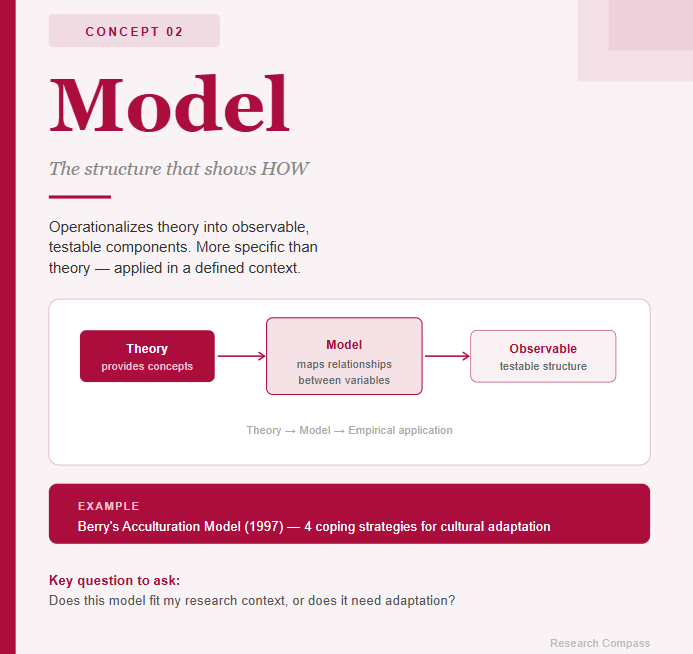
If a theory answers the question why, a model answers the question how. A model illustrates the relationships among elements and concepts often in diagrammatic or structural form, to explain or predict a phenomenon within a more specific context. Models are typically built upon one or more theories, but they go further by operationalizing those theoretical concepts into components that can be observed, measured, and tested.
This is the key distinction: a theory explains; a model operationalizes that explanation into something concrete enough for empirical research to act upon.
Example: Berry’s Acculturation and Coping Strategies Model (1997) draws on theories of cultural adaptation but extends them by specifying four distinct strategies that individuals may employ when navigating a new cultural environment: integration, assimilation, separation, and marginalization. The model doesn’t just help us understand why acculturation occurs. It gives researchers a structure for measuring and comparing specific adaptive responses.
Practical note: When selecting a model, examine carefully whether it genuinely fits your specific research context. A model developed within a Western context does not automatically transfer to research in Southeast Asia or other cultural settings. If you adapt or extend an existing model, explain the reasoning and basis for that adaptation clearly. This is one of the most meaningful ways to demonstrate your study’s theoretical contribution not replicating a model but developing it in a new context.
3. Framework — The Conceptual Map That Organizes Everything
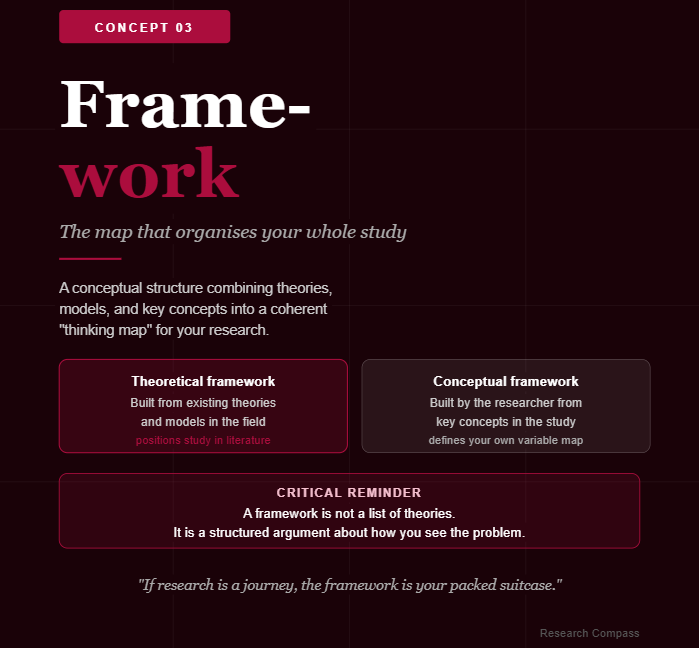
A framework is a conceptual structure built to organize and orient an entire research study. It may draw together multiple theories, models, and key concepts to create a kind of intellectual map, one that enables the researcher to analyze and interpret data systematically and consistently.
There are two common types, and the distinction between them matters more than most people realize:
A theoretical framework is built from established theories and models, and serves to position the research within the intellectual tradition of its field. As Varpio et al. (2020) describe it, a theoretical framework is the product of work, the active intellectual labor a researcher undertakes to demonstrate how theory shapes the research design: the questions asked, the way the context is approached, the data collection decisions, and the interpretive choices made at the end. In other words, constructing a theoretical framework is not simply a matter of selecting a theory. It is the work of translating that theory into a functioning structure within your specific study.
A conceptual framework, by contrast, is typically constructed by the researcher themselves, synthesizing the key concepts relevant to the research problem. It answers two essential questions: Why does this research need to be done? and What might these findings contribute to what is already known? It is more flexible than a theoretical framework, and reflects how the researcher defines the relationships among the core variables or concepts in their own study.
There is also a subtler point that often goes unaddressed: how a framework operates depends significantly on your research design. In deductive research (moving from theory to data), a theoretical framework is typically established before data collection begins. In inductive research (moving from data to theory), a framework may develop and evolve during data analysis. And this is entirely legitimate methodologically, not a sign of unpreparedness.
Example: A framework built on AMO Theory and Person-Environment Fit Theory to study the determinants of individual performance in organizations — integrating dimensions of ability, motivation, and opportunity alongside the fit between person and organizational context — would be one way to construct a purposeful theoretical framework that does real explanatory work.
Practical note: One of the most common errors is listing multiple theories without explaining how they connect to each other and why their combination serves your particular research. A framework is not a list. It is a structured argument about how you understand your research problem.
Make it explicit: How does your framework help answer your research question? What analytical direction does it give you? Which concepts are foregrounded, and why?
4. Approach — The Philosophy Behind the Method
A research approach is the overarching strategy or orientation a researcher adopts to carry out a study. It reflects not only how you collect and analyze data, but also your methodological stance and philosophical perspective — that is, what you believe about how knowledge is produced, and how reality can be studied.
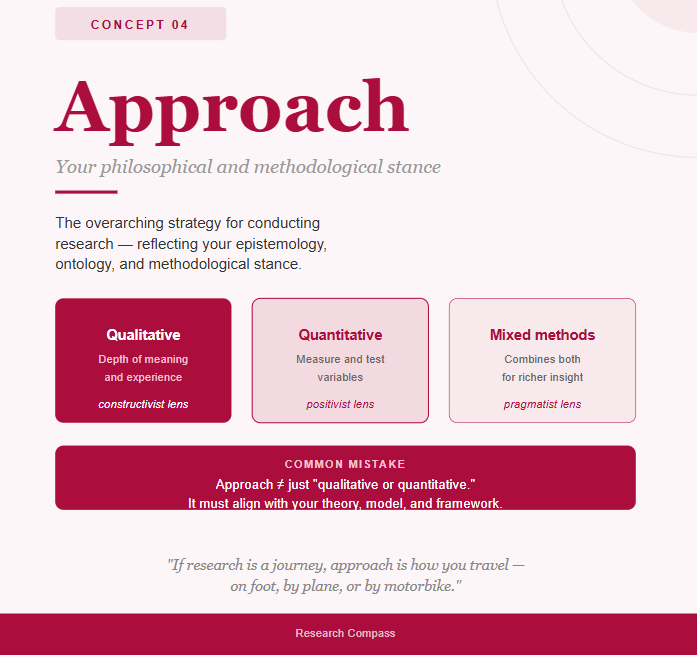
This is the dimension many people overlook: a research approach is not simply a choice between qualitative and quantitative. It is an expression of your epistemology (what you believe knowledge is and how it is generated) and your ontology (what you believe the nature of reality to be). A researcher working from a constructivist orientation believes that reality is socially constructed and inherently subjective; a positivist researcher believes there is an objective reality that exists independently of the observer. These two researchers will approach the same phenomenon in fundamentally different ways, not just in their methods, but in how they frame their questions, design their study, and interpret their findings.
Example: A qualitative approach is suited to exploring the depth of lived experience and meaning; a quantitative approach is suited to measuring variables and testing relationships; a mixed-methods approach allows both dimensions to be investigated within a single study.
Practical note: Your approach must be consistent with the theory, model, and framework you have chosen. And it must be capable of answering your research question. If you draw on a constructivist theory to explain a phenomenon but then adopt a purely quantitative approach without justifying that choice, reviewers will raise questions about the coherence of your research design. Articulating clearly why your chosen approach is the most appropriate for your research question is one of the most important things you can do in your Methodology chapter.
Four Points to Keep in Mind
Explain, don’t just name. A common problem in academic writing is naming a theory or framework without explaining why it was chosen and what role it plays. The presence of a theory in a paper is not the same as having a strong theoretical foundation. A theory only performs its function when it is clearly connected to the research question, the data, and the conclusions.
Use terms consistently. Each of these four concepts has a distinct role and cannot substitute for the others. Using “framework” when you mean “model,” or vice versa, does not merely create confusion. It quietly undermines the scholarly credibility of your work.
Go back to the original sources. Always consult the primary work of the scholars who developed the theories or models you are using. Understanding the original intent and context of a theory is a prerequisite for applying it accurately and for avoiding the kinds of misreading or mechanical application that reviewers notice immediately.
Key Takeaways
These four concepts do not exist in isolation. They form a logical chain within a research design:
Theory provides the explanatory foundation → Model operationalizes concepts into a testable structure → Framework organizes and orients the entire study → Approach guides the methodological and philosophical commitments of the research.
A few additional points worth holding onto:
A theory can be operationalized into a model when applied to a specific context. This is a common and legitimate step in empirical research design.
A framework is more flexible than either a theory or a model: It can be constructed by the researcher, provided it is clearly and carefully reasoned.
How a framework is used may differ depending on whether your study is deductive or inductive and that difference is not a weakness; it is an honest reflection of your research design.
Choosing a theory, model, or framework is not a purely technical decision. It expresses your epistemological and ontological commitments — your beliefs about the nature of knowledge and the nature of reality.
There is no single “correct” combination. What matters is not which theory you choose, but how you justify that choice and how consistently you enact it throughout your study.
If research is a journey, then:
Theory is your map of the world
Model is the specific route you have chosen
Framework is what you pack, the conceptual tools you bring to make sense of what you find
Approach is how you travel, the mode, the pace, the philosophy of the journey itself
Distinguishing and using Theory, Model, Framework, and Approach with precision is not simply about getting the terminology right. More fundamentally, it demonstrates that you understand why you are doing what you are doing in your research. And that understanding — reflective, intentional, and grounded — is the foundation of scholarship that is genuinely deep and genuinely convincing.