


The last research project I worked on as a research assistant was Belonging in Higher Education at the University of Windsor. My primary responsibility was to develop the literature review using the annotated bibliography method.
Now that my advisor and I have submitted the article to a journal, I want to share this approach. It is not a new technique, but it remains one of the most powerful tools for building a solid scholarly foundation for a big research project.
What is an annotated bibliography — and why does it matter?
An annotated bibliography is a carefully curated list of scholarly sources—articles, books, book chapters, dissertations—where each entry is accompanied by a short academic annotation.
Each annotation typically ranges from 100–300 words and includes:
A concise summary of the core argument
The theoretical framework or conceptual approach
The research methodology
The study’s scholarly contribution
Its relevance to your research question
A brief critical reflection (when needed)
The key point: an annotated bibliography is not simply a set of summaries. It is a thinking tool that helps you understand the intellectual structure of a research field.
A strong annotated bibliography demonstrates three core research competencies:
Source evaluation — recognizing which works are credible and why
Synthesis — identifying major lines of argument within the field
Positioning — beginning to see where your own work situates within that scholarly conversation
For this reason, in many projects an annotated bibliography is not a preliminary step. It is the foundation of the entire literature review.
When should you use an annotated bibliography?
This method is particularly valuable when:
You are entering a new research area
The topic contains multiple theoretical strands
You need to identify a research gap systematically
A research team must share a common literature base
In our project, my advisor and I reviewed and analyzed approximately 75 sources, including books, edited books, and journal articles. That number was large enough to construct a coherent and nuanced intellectual landscape of the topic.
A common misconception is that literature reviews require reading as much as possible. In reality, what matters more is reading strategically and synthesizing systematically.
Annotated bibliographies make that possible.
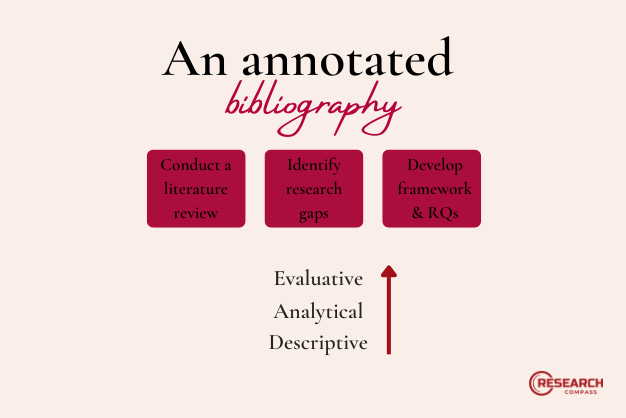
Three levels of annotated bibliography
Depending on your research goals, annotations can operate at three levels:
Descriptive — summarizing the source
Evaluative — assessing its scholarly value
Analytical — situating the source within broader theoretical debates
In academic research projects—especially academic journal articles—the analytical level is almost always necessary.
A strong annotation should answer three questions:
How does this study contribute to the broader intellectual landscape of the topic?
Does it extend, challenge, or replicate previous findings?
How does it inform my own research question?
Building an annotated bibliography like growing a “Knowledge Tree”
Here is the practical process I used in the Belonging project.
Step 1 — Define clear source selection criteria
Not every article containing the keyword belonging was included. We applied explicit criteria:
The study offered a clear theoretical contribution
It presented strong empirical evidence
It had significant influence within the field
Or it opened new directions for research
Step 2 — Write annotations using a consistent structure
Each source followed the same structure to allow comparison:
Research objective
Theoretical framework
Methodology
Key findings
Scholarly contribution
Relevance to the broader theme
Consistency becomes essential when working with dozens of sources.
Step 3 — Begin thematic grouping early
Do not wait until you begin writing the literature review. While drafting annotations, I could already see clusters of ideas emerging.
Step 4 — Move from annotation to thematic synthesis
A well-developed annotated bibliography naturally evolves into the structure of the literature review. It is like building the framework before writing the paper itself.
In our Belonging project, my supervisor organized the literature into seven thematic clusters:
Belonging in contemporary societies
Belonging in place-based learning
The digital context of participatory belonging
Belonging in online learning
Topologies of belonging
Belonging and youth mental health
Belonging during COVID-19
Writing careful annotations from the beginning makes the literature review faster to write later. It reduces repeated reading and makes it easier to revisit sources months or even years later.
For researchers working on belonging, the system we developed may also serve as a useful reference point.
A practical starting point
If you want to experiment with this approach, start small:
Select 20–30 core sources and/or journal articles
Write 150–200-word annotations for each including key information I listed above
Use the same structure for every entry
After 15–20 sources, begin identifying thematic clusters
Tools that work well for taking note include:
Excel or Google Sheets
Zotero
MAXQDA
Notion
Using an annotated bibliography ultimately helps answer the central question of any research project:
Which scholarly conversation am I entering and what will I contribute to it?
I hope this method encourages you to read more strategically, synthesize more thoughtfully, and write literature reviews on a stronger intellectual foundation.